Gold & Metals
What Are Gold Hallmarks and How Do You Read Them?
What gold hallmarks are, how independent assay marks differ from a maker's purity stamp, how regimes vary by country, and what Sri Lankan buyers should check.
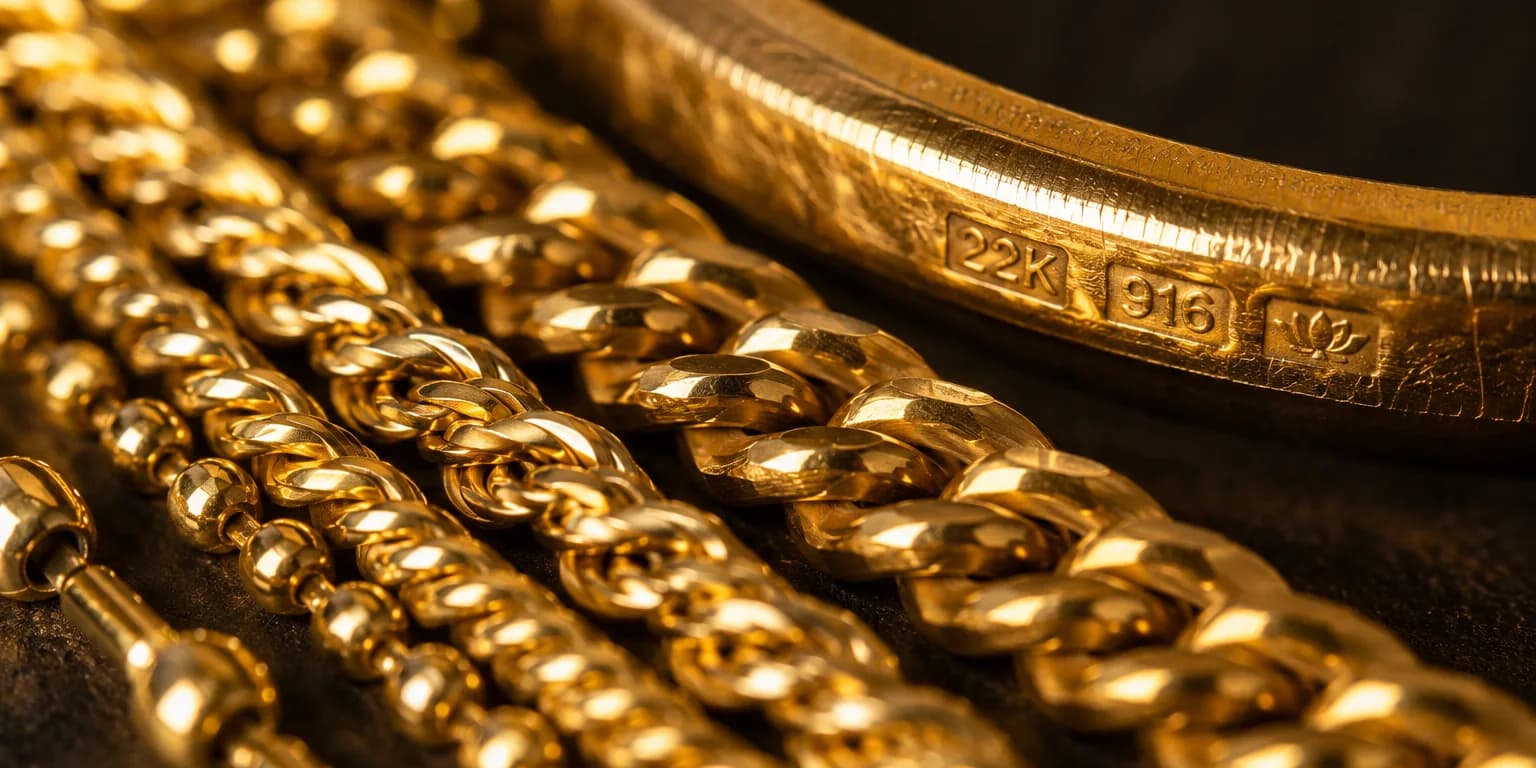
A hallmark is a mark applied to precious metal after independent testing by an assay office, certifying its fineness, distinct from a maker's own stamp such as 916 or 750, which is only a claim. Hallmarking regimes differ by country: some make marks compulsory, others voluntary. Practices in Sri Lanka vary, so buyers should always ask for the fineness in writing and test significant pieces.
The small cluster of marks punched inside a gold bangle looks official, and buyers routinely read it as a guarantee. Sometimes it is exactly that, the record of an independent laboratory test. Sometimes it is nothing more than the maker's own assertion. Knowing the difference is fundamental to buying gold anywhere, and especially in markets where practices vary.
What a Hallmark Actually Is
A hallmark in the strict sense is a mark struck onto precious metal by or under the authority of an assay office after the metal has been tested, assayed, and found to meet a declared fineness. The concept is centuries old and exists for one reason: gold alloys of very different value look identical, so an independent, accountable mark protects buyers where their eyes cannot.
That independence is the whole point. A hallmark says a third party tested this metal. A maker's own stamp says only the maker asserts this.
Hallmark Versus Purity Stamp
Most gold in Sri Lanka carries a fineness stamp, 916 on 22K, 750 on 18K, applied by the manufacturer. These numbers use the same notation a hallmark would, which is why they are so easily mistaken for one. The distinction is procedural, not visual: unless an independent assay body tested the piece and applied or authorised the mark, the stamp is a claim. Our guides to karat and fineness explain the notation itself.
How Regimes Differ Around the World
Hallmarking is a national affair and the spread is wide. Some countries operate compulsory systems in which jewellery above a threshold weight cannot legally be sold without assay marks; the United Kingdom's assay offices are the classic example, combining a fineness mark, an office symbol and a sponsor's mark. Other countries run voluntary schemes, and many have no formal regime at all. India has moved toward mandatory hallmarking of gold jewellery in recent years. Because rules change, verify the current position of any country whose marks you are relying on.
The Position in Sri Lanka
Marking practices on locally made jewellery vary between workshops and retailers, and buyers should not assume that any stamp reflects independent testing. The practical protections are therefore the ones this site returns to repeatedly: buy from established sellers, have the fineness and weight written on the invoice, and for significant purchases obtain independent gold testing or an assay report. Our hallmarking guide covers the documentation side in more depth.
Reading the Marks You Find
Examine marks with a loupe in good light. A three-digit number is a fineness claim; letters are usually a maker's or retailer's initials; symbols may belong to a foreign assay office if the piece was made or sold abroad. Worn, half-struck or suspiciously fresh marks on an old piece all justify a test before money changes hands, marks inform a purchase, but they should never conclude one.
Frequently asked questions
Is a 916 stamp a hallmark?
Not by itself. A fineness stamp applied by the maker is a claim about purity. A hallmark, strictly speaking, is applied after independent assay testing. Whether a given mark reflects independent testing depends on the country's system and the piece's origin.
Does Sri Lankan gold jewellery have to be hallmarked?
Marking practices in Sri Lanka vary between makers and retailers, and buyers should not assume any stamp reflects independent testing. Ask for the fineness in writing on the invoice and consider independent testing for significant pieces, rather than relying on marks alone.
What marks appear in a full hallmarking system?
Compulsory regimes such as the United Kingdom's typically combine a fineness number, the assay office's own symbol and a registered sponsor's or maker's mark, sometimes with a date letter. The exact set differs by country.
Can hallmarks be faked?
Yes, counterfeit punches exist, which is why hallmarks reduce risk rather than eliminate it. Buying from reputable sellers and testing significant pieces remain the buyer's underlying protections.
Related terms
Sources
- CIBJO, The World Jewellery Confederation, International guidance on precious metal marking and disclosure
- International Gem Society (IGS), Educational material on hallmarks and purity marks
- British Hallmarking Council: Guidance on Fineness, 916/22ct, 750/18ct and 585/14ct equivalence
- Assay Offices of Great Britain: Hallmarking Guidance Notes, Recognised gold fineness standards in UK hallmarking
- Goldsmiths’ Company Assay Office: UK Hallmarks, What a hallmark certifies
External references are provided for verification. Listing a source does not imply affiliation or endorsement.
Seen something that needs correcting? Read how corrections work or contact the editorial team.
Related Guides
Gold & Metals
What Does 916 Mean on Gold?
Why gold is stamped 916, how the number equals 22-karat purity at 91.6% gold, where the mark appears, and why a stamp alone is not proof of fineness.
2 min read
Gold & Metals
How Is Gold Tested? XRF, Touchstone, Acid and Fire Assay
The four main ways gold purity is tested, XRF, touchstone, acid and fire assay, what each can and cannot tell you, and when a buyer should insist on a test.
2 min read
Gold & Metals
Gold Karat vs Fineness: What Is the Difference?
Karat and fineness are two ways of writing the same gold purity. How the 24-part karat scale maps to parts-per-thousand fineness, with a full conversion table.
2 min read
Gold & Metals
What Is Sterling Silver and What Does 925 Mean?
What sterling silver is, why the 925 standard of 92.5% silver became universal, how to read silver marks, and how to care for sterling jewellery properly.
2 min read