Certificates
What Is Hallmarking and What Do the Marks on Gold Mean?
How hallmarking attests to precious-metal fineness, what common marks mean, why practice differs between countries, and what to check when buying in Sri Lanka.

Hallmarking is the marking of precious-metal articles to attest to their fineness, in formal systems applied after independent assay. The marks typically identify the metal's fineness and, depending on the system, the maker and the assaying body. Practice varies by country: where no compulsory scheme operates, purity stamps are the maker's own claim rather than an independent attestation.
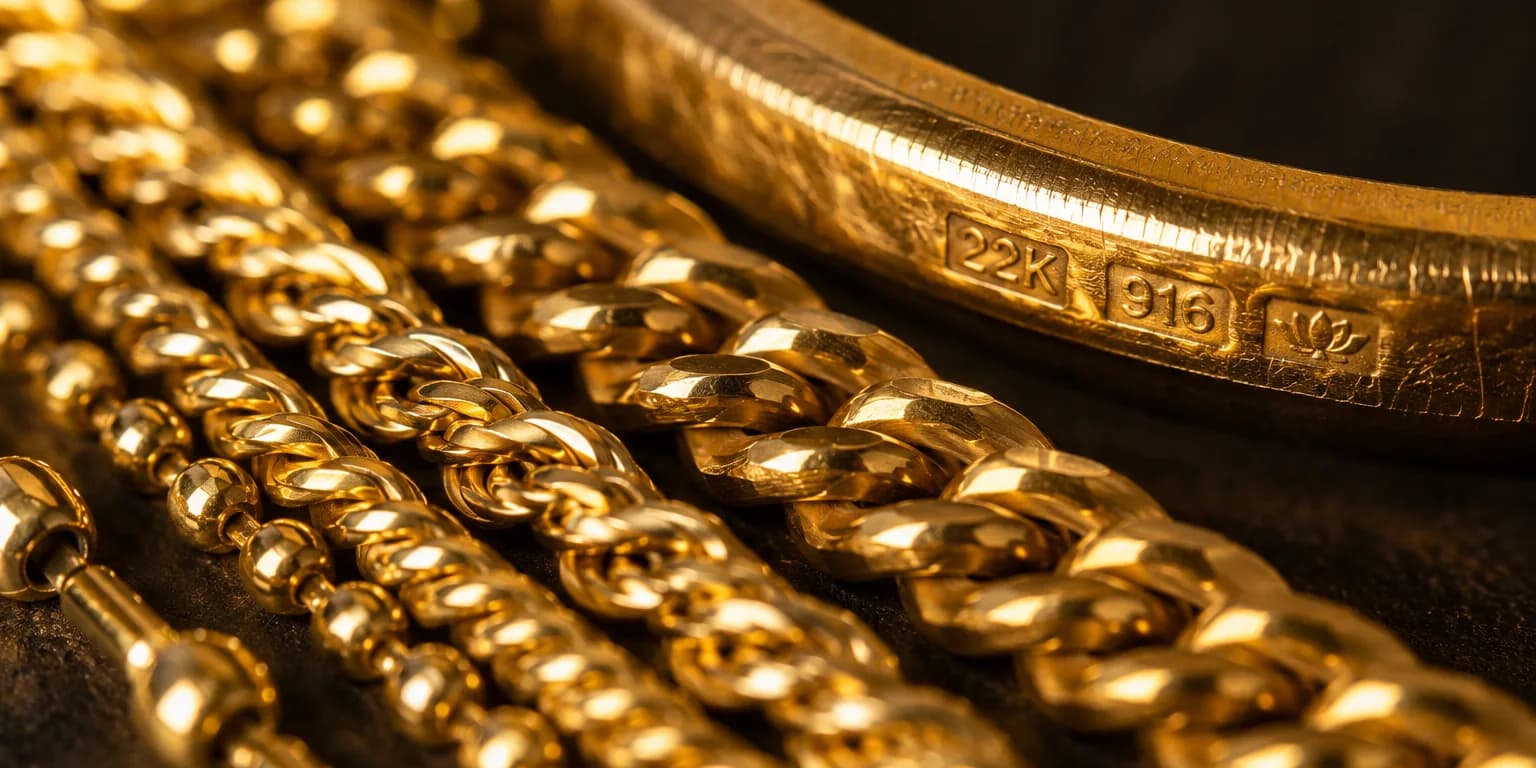
Turn over almost any piece of gold jewellery and you will find tiny marks, numerals, letters, sometimes miniature symbols. Buyers often assume all such marks are official guarantees. Sometimes they are; sometimes they are simply the maker's own stamp. Knowing which is which is the whole art of reading a hallmark.
The Idea Behind Hallmarking
A hallmark exists to solve gold's oldest problem: purity is invisible. In a formal hallmarking system, an independent body assays an article, tests its actual composition, and then strikes marks attesting to the fineness found. The mark converts a private test into a public, durable statement on the metal itself.
Hallmarking in this strict sense is among the oldest forms of consumer protection, and its logic is unchanged: the party attesting to purity should not be the party selling the piece.
What the Marks Say
Systems differ, but the recurring elements are a fineness numeral, and in fuller schemes, marks identifying the maker or sponsor and the assaying body, sometimes with a date indication. The fineness numerals are the most internationally consistent part:
| Numeral | Metal and equivalent |
|---|---|
| 916 | Gold, 22 karat |
| 750 | Gold, 18 karat |
| 585 | Gold, 14 karat |
| 925 | Sterling silver |
A detailed reading guide for gold marks is in gold hallmarks.
Marks With and Without a System Behind Them
Here practice divides sharply by country. Some jurisdictions operate compulsory hallmarking: precious-metal articles must be independently assayed and marked before sale, and the marks carry legal weight. Others run voluntary schemes, and many have no formal scheme at all, there, a stamp such as 916 is applied by the manufacturer or retailer and stands as their claim, backed by their reputation rather than an independent office.
Neither situation makes a stamp meaningless. It does mean the same numerals can represent different levels of assurance in different markets, and a careful buyer asks which kind of mark they are looking at.
What This Means for Buyers in Sri Lanka
For gold bought in Sri Lanka, treat purity stamps as claims worth checking rather than as automatic attestations. Ask the seller directly what standard the piece is made to and whether it has been independently assayed. For substantial purchases, independent testing, described in our guides to assay reports and gold testing, is inexpensive relative to what it protects.
Marking practice and any applicable requirements can change, so verify the current position with official Sri Lankan sources before relying on it; this guide describes the general landscape, not the current regulation in detail.
A Buyer's Short Checklist
Look for marks with a loupe and note them before purchase. Ask what each mark means and who applied it. Insist that the claimed karat or fineness appears on the invoice in writing. And where the piece's value justifies it, test rather than trust: an assay settles in minutes what a stamp can only assert.
Frequently asked questions
Does every country hallmark gold jewellery?
No. Some countries operate long-established compulsory systems with independent assay offices; others have voluntary schemes or none at all. The meaning of a mark therefore depends on where and under which system it was struck.
What does 916 stamped on gold mean?
It claims a fineness of 916 parts per thousand, 91.6 per cent gold, equivalent to 22 karat. Whether that claim has been independently verified depends on whether the mark was applied under a formal hallmarking scheme or by the maker alone.
Is unmarked gold necessarily impure?
No. Older pieces, handmade items and jewellery from places without marking requirements may carry no marks at all and still be fine gold. Absence of a mark is a reason to test, not a verdict.
How should a buyer in Sri Lanka treat purity stamps?
As claims worth checking. Ask the seller what the stamp means and whether the piece has been independently assayed, have significant purchases tested, and verify current local marking practice with official sources rather than assuming a foreign system's rules apply.
Related terms
Sources
- National Gem and Jewellery Authority of Sri Lanka (NGJA), Public-body context for jewellery trade standards in Sri Lanka, reference only, no affiliation
- CIBJO, The World Jewellery Confederation, Precious-metal marking and disclosure terminology, reference only, no affiliation
External references are provided for verification. Listing a source does not imply affiliation or endorsement.
Seen something that needs correcting? Read how corrections work or contact the editorial team.
Related Guides
Certificates
What Is an Assay Report and When Do You Need One?
How assaying establishes the precious-metal content of gold and silver, what an assay report states, and how it relates to hallmarks and fineness marks.
2 min read
Certificates
What Is a Jewellery Valuation and What Is It Actually For?
What a jewellery valuation covers, how it differs from a laboratory identification report, and why insurance replacement value is not the same as resale value.
2 min read
Gold & Metals
What Are Gold Hallmarks and How Do You Read Them?
What gold hallmarks are, how independent assay marks differ from a maker's purity stamp, how regimes vary by country, and what Sri Lankan buyers should check.
2 min read
Gold & Metals
How Is Gold Tested? XRF, Touchstone, Acid and Fire Assay
The four main ways gold purity is tested, XRF, touchstone, acid and fire assay, what each can and cannot tell you, and when a buyer should insist on a test.
2 min read