Gold & Metals
How Is Gold Tested? XRF, Touchstone, Acid and Fire Assay
The four main ways gold purity is tested, XRF, touchstone, acid and fire assay, what each can and cannot tell you, and when a buyer should insist on a test.
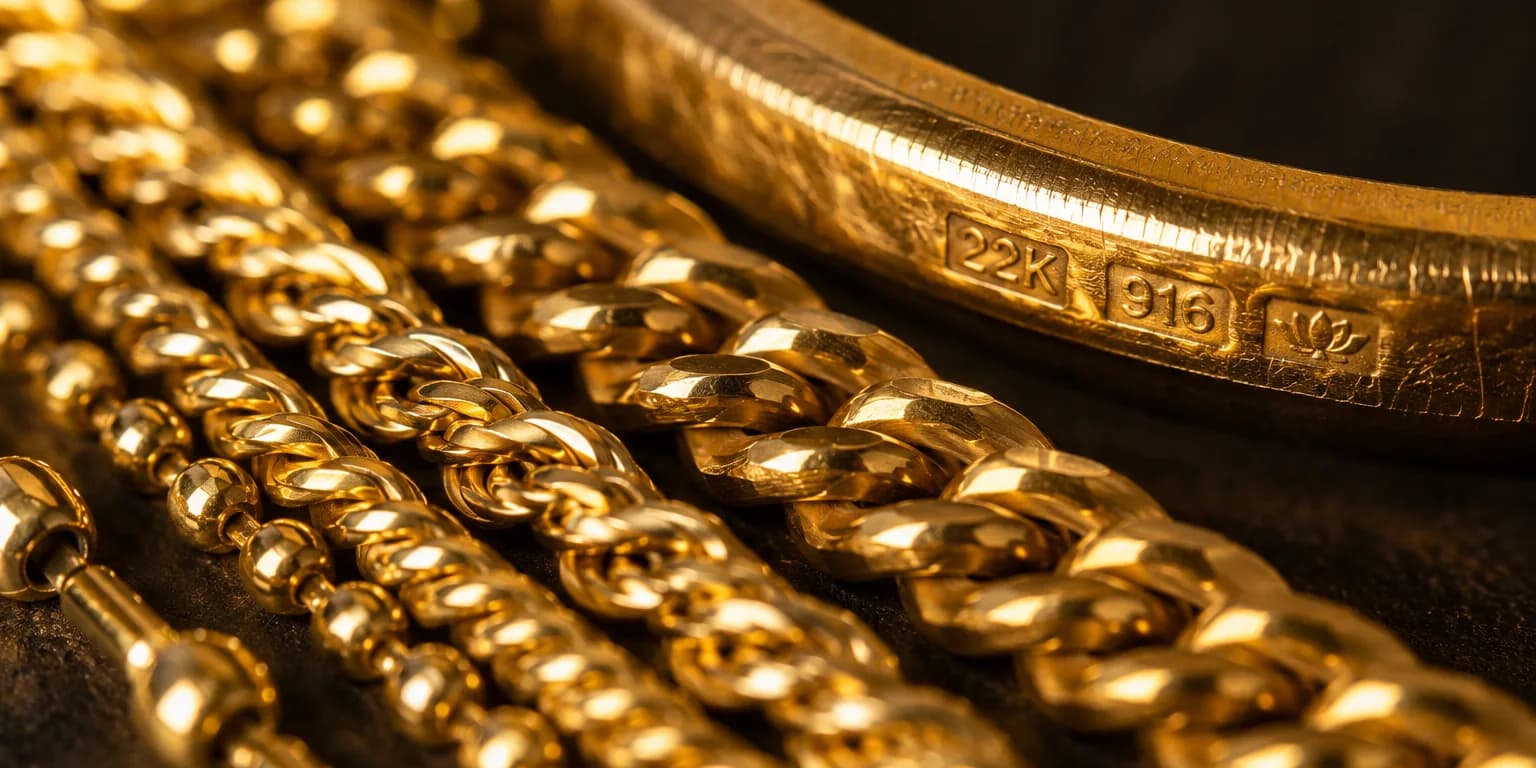
Gold is tested for purity by four main methods: X-ray fluorescence (XRF), which reads the alloy quickly and non-destructively; the traditional touchstone comparison; acid testing, which observes how streaks of the metal react to test acids; and fire assay, the definitive laboratory method. For any significant purchase or resale, an independent test is worth far more than the stamp on the metal.
Every claim about gold, the 916 stamp, the seller's assurance, the family story about a bangle's purity, eventually meets the same arbiter: a test. Gold testing is quick, inexpensive and widely available, yet many buyers have never watched one performed. Knowing what each method does, and where each can be fooled, turns testing from ritual into protection.
XRF: The Modern Standard
X-ray fluorescence (XRF) spectrometry is today's workhorse. The instrument irradiates a small spot and reads the characteristic energies the alloy emits, reporting the composition, gold, silver, copper and the rest, in seconds, without touching the piece. Benchtop and handheld units are now common in serious shops, buying counters and laboratories.
XRF's limitation is depth: it reads the surface layers, so heavy plating over base metal can deceive a single reading. Competent testers therefore measure several spots, including clasps, posts and worn edges, and treat inconsistent readings as a reason to dig further.
Touchstone: The Oldest Test
The touchstone method is thousands of years old and still in daily use. The tester draws the item across a fine-grained black stone, leaving a streak of metal, then compares its behaviour, often under acid, against streaks from needles of known fineness. In experienced hands it separates the common grades reliably; in inexperienced hands it is guesswork. It removes only a trace of metal from an inconspicuous edge.
Acid Testing
Acid testing extends the touchstone principle: test acids of graded strength are applied to a streak or a small filed spot, and the reaction, dissolving, discolouring or standing unchanged, brackets the karat. Kits are cheap and common at buying counters. The method is serviceable for sorting, but it reads only the surface, involves corrosive chemicals and offers nothing like XRF's precision.
Fire Assay: The Definitive Answer
Fire assay, or cupellation, is the ancient laboratory method against which the others are judged. A weighed sample is melted with fluxes and lead, the base metals are driven off, and the remaining precious metal is weighed to determine gold content with great accuracy. Its precision comes at an obvious cost, the sample is destroyed, so fire assay belongs to refining, bullion and formal assay work rather than finished jewellery. Formal results may be documented in an assay report.
When a Buyer Should Insist on Testing
Test before you rely: on any significant purchase, on any piece bought without documentation, and on anything you are selling, where the buyer's test sets the price, watch it done and ask to see the reading. Remember that a stamp such as 916 is a claim, and hallmarking practices vary between countries and makers. A sixty-second XRF reading, with the result written on the invoice, settles what no mark can.
Frequently asked questions
Which gold test is the most accurate?
Fire assay remains the laboratory benchmark for gold content, but it is destructive, so it is used for refining and formal assay rather than finished jewellery. For intact pieces, properly calibrated XRF is the practical standard.
Can XRF be fooled by gold-plated items?
It can be misled, because XRF reads the surface layers. A thick gold plating over base metal may test well at the surface, which is why testers check multiple spots, look at edges and clasps, and combine XRF with weight and density checks.
Do home gold tests work?
Magnet checks and density measurements can expose crude fakes but cannot establish fineness, and acid kits used untrained damage pieces and mislead. For anything of value, professional testing is inexpensive and conclusive.
Will testing damage my jewellery?
XRF is completely non-destructive. Touchstone and acid tests remove a trace of metal at an inconspicuous spot, negligible on most pieces. Only fire assay destroys the sample, and it is not used on jewellery you intend to keep.
Related terms
Sources
- CIBJO, The World Jewellery Confederation, Standards for precious metal fineness and its verification
- International Gem Society (IGS), Educational material on gold testing methods
External references are provided for verification. Listing a source does not imply affiliation or endorsement.
Seen something that needs correcting? Read how corrections work or contact the editorial team.
Related Guides
Gold & Metals
What Are Gold Hallmarks and How Do You Read Them?
What gold hallmarks are, how independent assay marks differ from a maker's purity stamp, how regimes vary by country, and what Sri Lankan buyers should check.
2 min read
Gold & Metals
What Does 916 Mean on Gold?
Why gold is stamped 916, how the number equals 22-karat purity at 91.6% gold, where the mark appears, and why a stamp alone is not proof of fineness.
2 min read
Gold & Metals
Gold Karat vs Fineness: What Is the Difference?
Karat and fineness are two ways of writing the same gold purity. How the 24-part karat scale maps to parts-per-thousand fineness, with a full conversion table.
2 min read
Gold & Metals
What Is Sterling Silver and What Does 925 Mean?
What sterling silver is, why the 925 standard of 92.5% silver became universal, how to read silver marks, and how to care for sterling jewellery properly.
2 min read