Gold & Metals
What Does 916 Mean on Gold?
Why gold is stamped 916, how the number equals 22-karat purity at 91.6% gold, where the mark appears, and why a stamp alone is not proof of fineness.
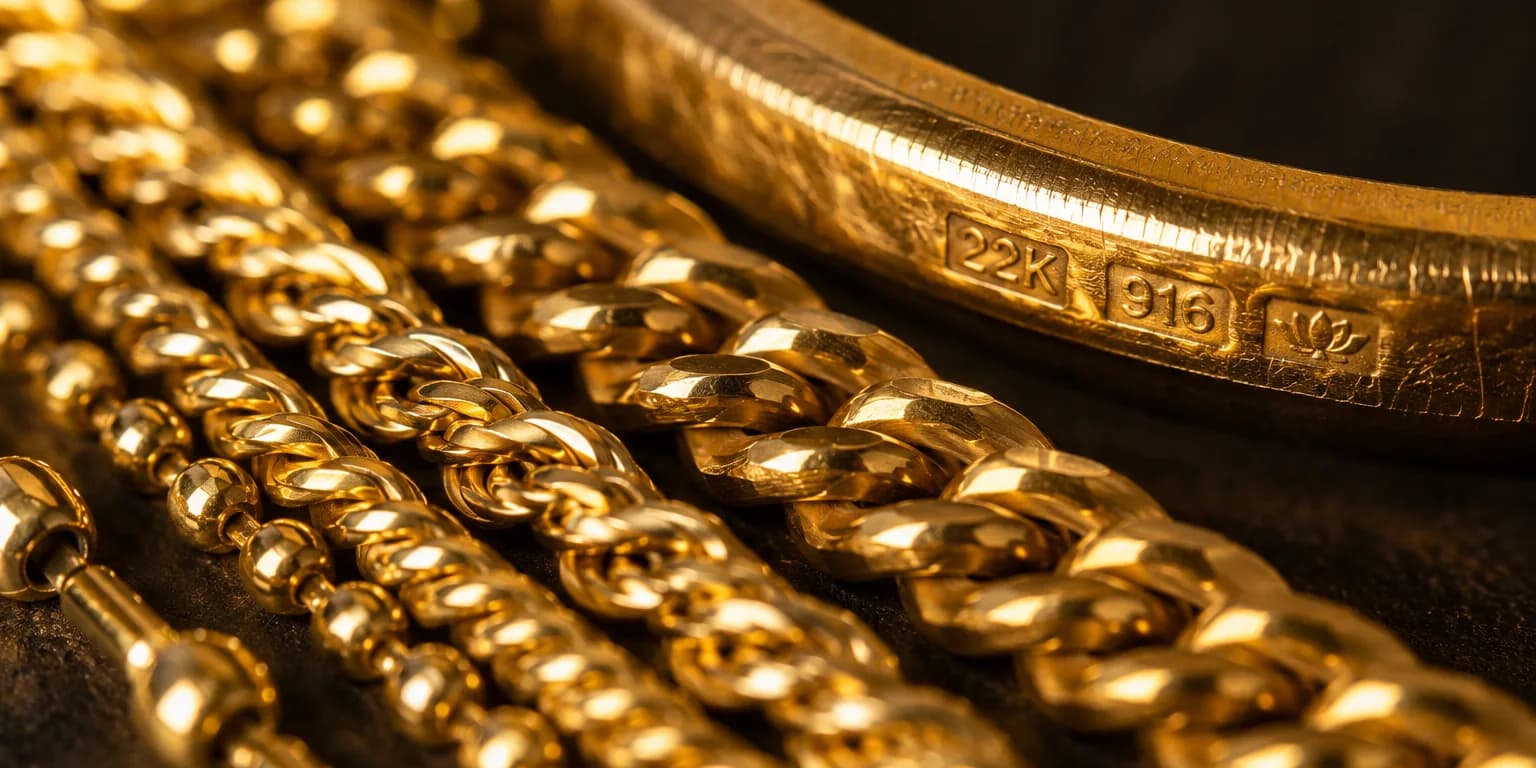
A 916 stamp on gold means the metal is claimed to be 916 parts gold per thousand, 91.6% pure, which is exactly 22 karat. It is the standard purity mark on traditional South Asian jewellery, including most Sri Lankan gold. The stamp is the maker's claim, not an independent certification, so buyers should still ask for fineness in writing and test significant pieces.
Turn over almost any gold bangle sold in Sri Lanka and you will find three small digits punched into the metal: 916. The number is shorthand the entire South Asian gold trade runs on, but what it guarantees, and what it does not, is worth understanding before you rely on it.
The Arithmetic Behind 916
Gold purity can be written two ways. The traditional karat scale divides purity into 24 parts; the modern fineness system expresses it in parts per thousand. 22 karat means 22/24ths gold, and 22 ÷ 24 = 0.9166, so 22K gold is 916 parts per thousand, or 91.6% pure. The stamp simply records that fineness on the metal itself.
The same logic produces the other familiar marks: 999 for 24K, 875 for 21K, 750 for 18K and 585 for 14K. Our karat versus fineness guide sets out the full conversion.
Where You Will See the Mark
916 appears on the inner surfaces of bangles, on clasp tongues, ring shanks and pendant bails, anywhere a small punch will not spoil the design. In Sri Lanka it is the default mark on traditional jewellery because the local trade works overwhelmingly in 22K gold. Alongside the number you may also find a maker's or retailer's initials, and in some countries additional symbols applied under national hallmarking schemes.
A Stamp Is a Claim, Not a Certificate
This is the point buyers most often miss. A 916 punch can be bought and applied by anyone; the stamp records what the maker asserts, nothing more. Formal hallmarking, where an independent assay office tests the metal before marking it, exists in some countries, but regimes differ widely, and marking practices in Sri Lanka vary between makers and retailers. Treat the stamp as a starting point, and treat the invoice as the document that matters: ask the seller to state the weight and fineness in writing.
How 916 Is Verified
When real confirmation is needed, jewellers and laboratories use gold testing methods: X-ray fluorescence (XRF) gives a fast, non-destructive surface reading; touchstone and acid testing are the traditional counter methods; and fire assay remains the definitive laboratory technique. For a significant purchase, a test result or an assay report is worth far more than any punch mark.
What 916 Means for Price
Because 916 gold is 91.6% pure, its metal value is about 91.6% of the pure-gold rate for the same weight, the basis of the "22K rate" on shop boards. The gold price per gram guide shows how that rate is built, and the gold purity calculator converts between purities instantly. When comparing quotes, always confirm the price refers to 916 metal and not a lower fineness dressed in the same yellow colour.
Frequently asked questions
Is 916 gold the same as 22K gold?
Yes. 916 and 22K describe the same purity in two notations: 916 parts per thousand equals 22 parts out of 24, both meaning 91.6% pure gold.
Does a 916 stamp guarantee the gold is genuine?
No. A stamp can be applied to any metal, and underkarating, stamping a higher purity than the metal contains, is a known abuse in many markets. Testing by XRF or assay is what actually verifies fineness.
Why is my 22K jewellery stamped 916 and not 917?
22 divided by 24 is 91.66...%, and the trade convention rounds the fineness mark down to 916. Some standards describe 22K as 916 or 917; in practice South Asian jewellery uses 916.
What should I do if a piece has no stamp at all?
Unmarked gold is not necessarily impure, but you are relying entirely on the seller. Ask for the fineness in writing on the invoice and consider independent testing before paying for significant pieces.
Related terms
Sources
- CIBJO, The World Jewellery Confederation, Fineness notation and precious metal marking conventions
- International Gem Society (IGS), Educational material on gold purity marks
- British Hallmarking Council: Guidance on Fineness, 916 fineness corresponds to 22 carat gold
External references are provided for verification. Listing a source does not imply affiliation or endorsement.
Seen something that needs correcting? Read how corrections work or contact the editorial team.
Related Guides
Gold & Metals
22K Gold in Sri Lanka: 916 Purity and Why It Dominates
What 22K gold is, why its 916 fineness makes it 91.6% pure, and why it is the standard purity for traditional jewellery across Sri Lanka and South Asia.
2 min read
Gold & Metals
What Are Gold Hallmarks and How Do You Read Them?
What gold hallmarks are, how independent assay marks differ from a maker's purity stamp, how regimes vary by country, and what Sri Lankan buyers should check.
2 min read
Gold & Metals
How Is Gold Tested? XRF, Touchstone, Acid and Fire Assay
The four main ways gold purity is tested, XRF, touchstone, acid and fire assay, what each can and cannot tell you, and when a buyer should insist on a test.
2 min read
Gold & Metals
Gold Karat vs Fineness: What Is the Difference?
Karat and fineness are two ways of writing the same gold purity. How the 24-part karat scale maps to parts-per-thousand fineness, with a full conversion table.
2 min read