Certificates
What Does a Gem Identification Report Actually Determine?
What a gem identification report establishes, species, variety, natural or synthetic status and detected treatments, and why it is the baseline document.
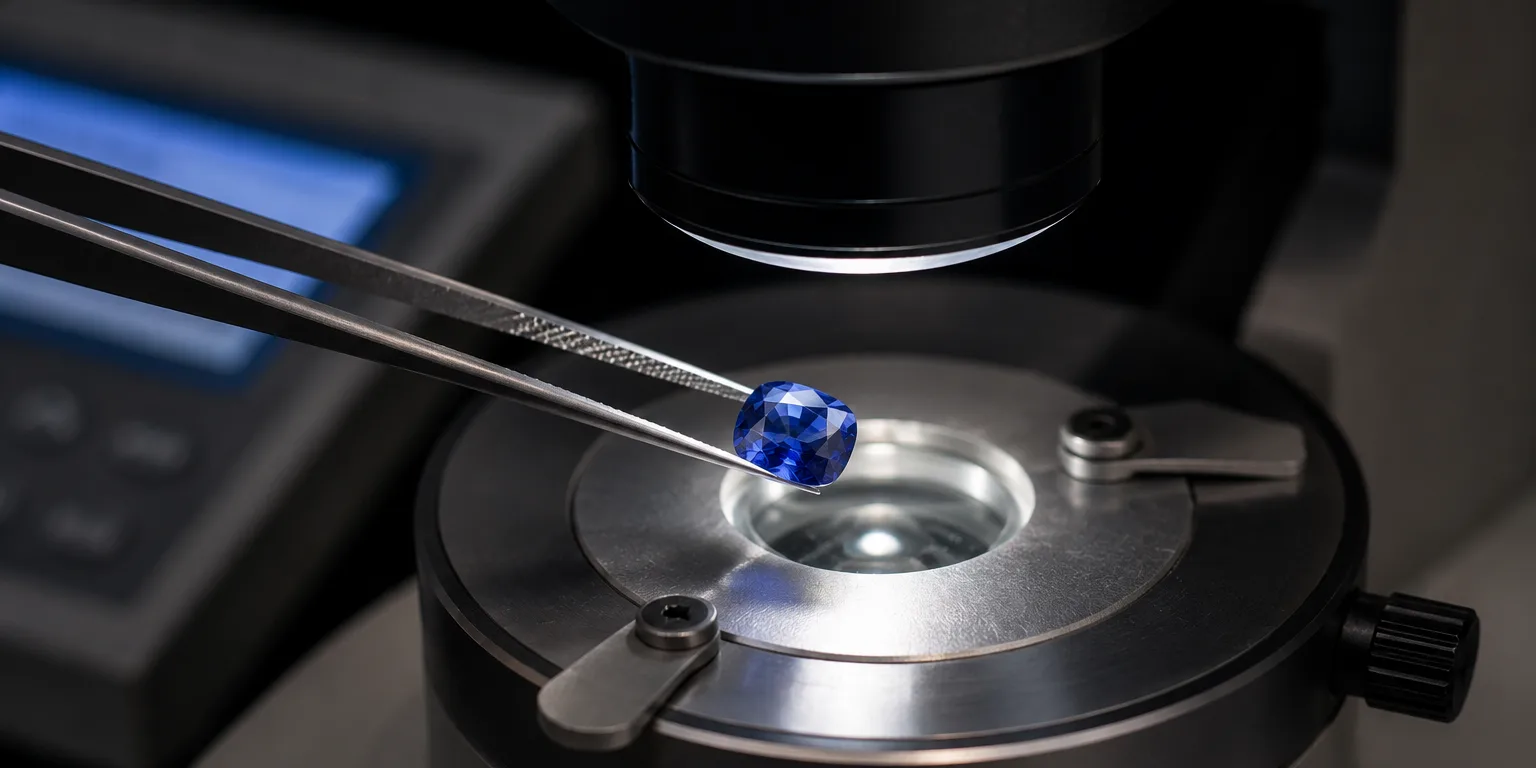
A gem identification report determines what a stone is: its species and variety, whether it is natural, synthetic or an imitation, and which treatments were detected during examination. It is the baseline laboratory document for any coloured stone, and every other report type builds on the identity it establishes.
Every claim a seller makes about a gemstone rests on one prior question: what is the stone? An identification report is the laboratory document that answers it. Before origin, before treatment nuance, before any discussion of value, identification establishes the facts on which everything else depends.
The Question Identification Answers
An identification report states the species and variety of the stone, for instance, that it is corundum, variety sapphire, and whether it is natural, synthetic or an imitation. These are findings of fact, reached by testing, and they are the core of any gem report.
The distinction matters because visually similar materials occupy utterly different markets. A natural sapphire, a synthetic sapphire and a piece of blue glass can look alike in a shop window; they are not alike in any other respect.
Natural, Synthetic or Imitation
The three findings deserve careful separation. A natural stone formed in the earth. A synthetic was grown by people but shares the natural stone's essential chemistry and structure, synthetic sapphire is genuinely corundum. An imitation only resembles the gem it copies and may be glass, plastic or a different mineral entirely.
None of these words is an accusation; synthetics and imitations are legitimate products when sold as what they are. The report's job is to remove any gap between what a stone is and what it is called.
How Laboratories Reach the Conclusion
Identification combines standard gemmological measurements, such as refractive index and specific gravity, with microscopic examination of the stone's internal features, supplemented where needed by advanced spectroscopic and chemical analysis. Inclusions are often decisive: natural stones and synthetics tend to carry different internal signatures, legible to a trained examiner.
The buyer does not need to master these methods. What matters is that the conclusion rests on measurement and observation, not on the parcel paper or the seller's description.
Treatment Disclosure Within Identification
At reputable laboratories, identification work routinely includes disclosure of detected treatments, stated in the report's comments. For sapphires this usually means whether there is evidence of heating. The subject is large enough to deserve its own guide, see treatment reports, but buyers should expect treatment findings as part of any full identification document.
What Identification Does Not Cover
An identification report does not usually state geographic origin, which is a separate opinion covered in our guide to origin reports. It does not grade quality, and it never states a market price. It describes the stone as examined on the report date; recutting or damage after that date is outside its scope.
When to Insist on One
For any significant purchase, and for any stone whose price rests on being natural and untreated, an independent identification report is the baseline document to request. A seller's reluctance to allow independent testing is one of the clearest warning signs in the trade, discussed further in red flags when buying gemstones. Once you have a report in hand, our guide to reading a gem report explains every field.
Frequently asked questions
What is the difference between a synthetic and an imitation gemstone?
A synthetic has essentially the same chemical composition and structure as its natural counterpart but was made by people, synthetic sapphire is still corundum. An imitation merely looks like the gem it copies: blue glass imitating sapphire is an imitation, not a synthetic.
Can a jeweller identify a gemstone by eye?
Experienced professionals can often form a strong view, but visual inspection cannot reliably separate natural from synthetic material or detect many treatments. Laboratory testing exists precisely because appearance alone is not proof.
Does an identification report tell me where a stone was mined?
Not usually. Geographic origin is a separate opinion offered by some laboratories for certain species. An identification report establishes what the stone is, not where it formed.
Is an identification report worth it for a small purchase?
For inexpensive stones the testing may cost a meaningful fraction of the price, so many buyers accept the seller's written disclosure instead. For significant purchases, independent identification is the standard protection.
Related terms
Sources
- Gemological Institute of America (GIA), Identification concepts and terminology, reference only, no affiliation
- CIBJO, The World Jewellery Confederation, Definitions of natural, synthetic and imitation materials, reference only, no affiliation
External references are provided for verification. Listing a source does not imply affiliation or endorsement.
Seen something that needs correcting? Read how corrections work or contact the editorial team.
Related Guides
Certificates
What Are Gem Certificates and What Do They Actually Tell You?
An overview of gemstone laboratory reports, what identification, origin and treatment documents cover, what they cannot guarantee, and why they matter.
3 min read
Certificates
How Do Laboratory Reports Disclose Gemstone Treatments?
How laboratories detect and disclose gemstone treatments, why the wording on a report matters, and how treatment findings change what a stone is worth.
2 min read
Certificates
What Is a Gemstone Origin Report and How Reliable Is It?
How laboratories form geographic origin opinions for gemstones, why the conclusion is an opinion rather than a certainty, and what origin adds to value.
2 min read
Buying Guides
What Are the Red Flags When Buying Gemstones?
Ten red flags when buying gemstones, pressure tactics, resale-profit stories, fantasy discounts and documentation dodges, and why each one matters.
3 min read