Gold & Metals
What Is 21K Gold?
What 21K gold is, why its 875 fineness equals 87.5% pure gold, where this purity is popular, and how it compares with the 22K standard used in Sri Lanka.
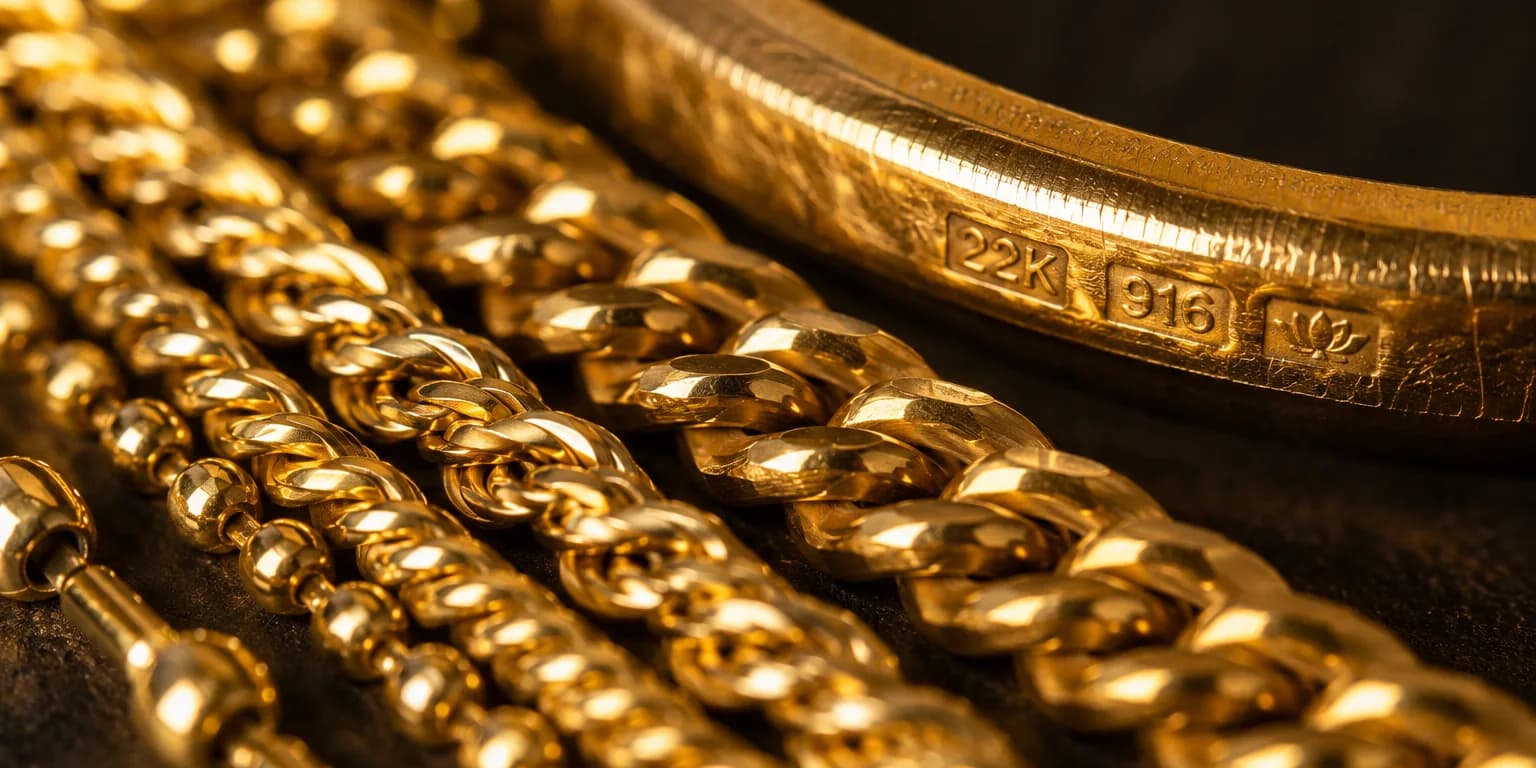
21K gold contains 21 parts gold out of 24, a fineness of 875, or 87.5% pure gold. It sits between the South Asian 22K standard and 18K fine jewellery gold, and is especially associated with Middle Eastern markets. In Sri Lanka it is less common than 22K, but travellers and buyers of Gulf jewellery encounter it often.
21K gold occupies a distinctive place on the purity scale: one karat below the South Asian standard, noticeably above European fine-jewellery gold, and firmly associated with the jewellery souks of the Middle East. For Sri Lankan buyers, it most often appears in pieces brought home from the Gulf.
What 21K Means
On the karat scale, 21K means 21 parts gold out of 24. As fineness, that is 875 parts per thousand, 87.5% pure gold, and "875" is the number stamped inside 21K pieces. The remaining 12.5% is alloying metal, typically copper and silver, which deepens or cools the colour depending on the mix.
| Karat | Fineness mark | Gold content |
|---|---|---|
| 24K | 999 | ~99.9% |
| 22K | 916 | 91.6% |
| 21K | 875 | 87.5% |
| 18K | 750 | 75.0% |
| 14K | 585 | 58.5% |
Where 21K Gold Is Popular
21K is a hallmark purity of Middle Eastern markets, Saudi Arabia, the Gulf states, Egypt and the Levant, where it balances the region's preference for high-gold-content jewellery with slightly better durability and a marginally lower price than 22K. Many Sri Lankans working in or travelling through the Gulf return with 21K chains, bangles and sets, which is the main route by which the purity enters the local market.
21K Versus 22K
The two grades are close relatives. A 21K piece contains about 4% less pure gold per gram than 22K gold, making it correspondingly cheaper on metal value; it is also fractionally harder, though the practical difference in wear is modest. Colour is very similar, a rich yellow that most eyes cannot separate from 22K without the stamp.
The distinction matters most at resale. A Sri Lankan jeweller valuing an unmarked yellow bangle will test it, and a piece assumed to be 916 that assays at 875 is worth measurably less. Checking the stamp, and having significant pieces tested, avoids that surprise.
Buying and Selling 21K in Sri Lanka
When buying, insist that the invoice records the weight and the fineness as 875, not simply "gold". When selling or trading in a 21K piece locally, expect valuation at 87.5% purity after gold testing; reputable buyers will show you the test result and the rate applied. Our gold purity calculator converts between karat, fineness and gold content if you want to check the arithmetic yourself.
The Bottom Line
21K is a legitimate, high-purity jewellery gold with a strong regional tradition behind it. Treat it on its own terms: confirm the 875 mark, value it at its true gold content, and compare it against 22K and 18K using fineness rather than appearance.
Frequently asked questions
Is 21K gold common in Sri Lanka?
No. Sri Lankan jewellers work overwhelmingly in 22K, with 18K for gem-set pieces. 21K items in Sri Lanka usually arrive with travellers returning from Gulf countries, where the purity is a market standard.
Is 21K gold worth less than 22K?
Per gram, yes, in proportion to its gold content: 87.5% against 91.6%. The difference is about 4% of the pure gold value, before making charges are considered.
Will a Sri Lankan jeweller buy back 21K gold?
Generally yes, but on metal content. Expect the piece to be tested and valued at 875 fineness rather than the local 916 norm, and confirm the rate applied before agreeing to sell.
How can I tell 21K from 22K by eye?
You usually cannot, the colour difference is slight. Look for the 875 or 916 stamp and, for valuable pieces, rely on testing rather than appearance.
Related terms
Sources
- CIBJO, The World Jewellery Confederation, International fineness standards for gold alloys
- International Gem Society (IGS), Educational material on gold karat systems
External references are provided for verification. Listing a source does not imply affiliation or endorsement.
Seen something that needs correcting? Read how corrections work or contact the editorial team.
Related Guides
Gold & Metals
22K Gold in Sri Lanka: 916 Purity and Why It Dominates
What 22K gold is, why its 916 fineness makes it 91.6% pure, and why it is the standard purity for traditional jewellery across Sri Lanka and South Asia.
2 min read
Gold & Metals
What Is 18K Gold?
What 18K gold is, why its 750 fineness means 75% pure gold, and why it is the preferred purity for gem-set, white and rose gold jewellery worldwide.
2 min read
Gold & Metals
Gold Karat vs Fineness: What Is the Difference?
Karat and fineness are two ways of writing the same gold purity. How the 24-part karat scale maps to parts-per-thousand fineness, with a full conversion table.
2 min read
Gold & Metals
What Does 916 Mean on Gold?
Why gold is stamped 916, how the number equals 22-karat purity at 91.6% gold, where the mark appears, and why a stamp alone is not proof of fineness.
2 min read