Jewellery
What Makes Handmade Jewellery Different?
What handmade jewellery means in Sri Lanka, traditional techniques, how handwork differs from casting, how to recognise it and why buyers pay more for it.
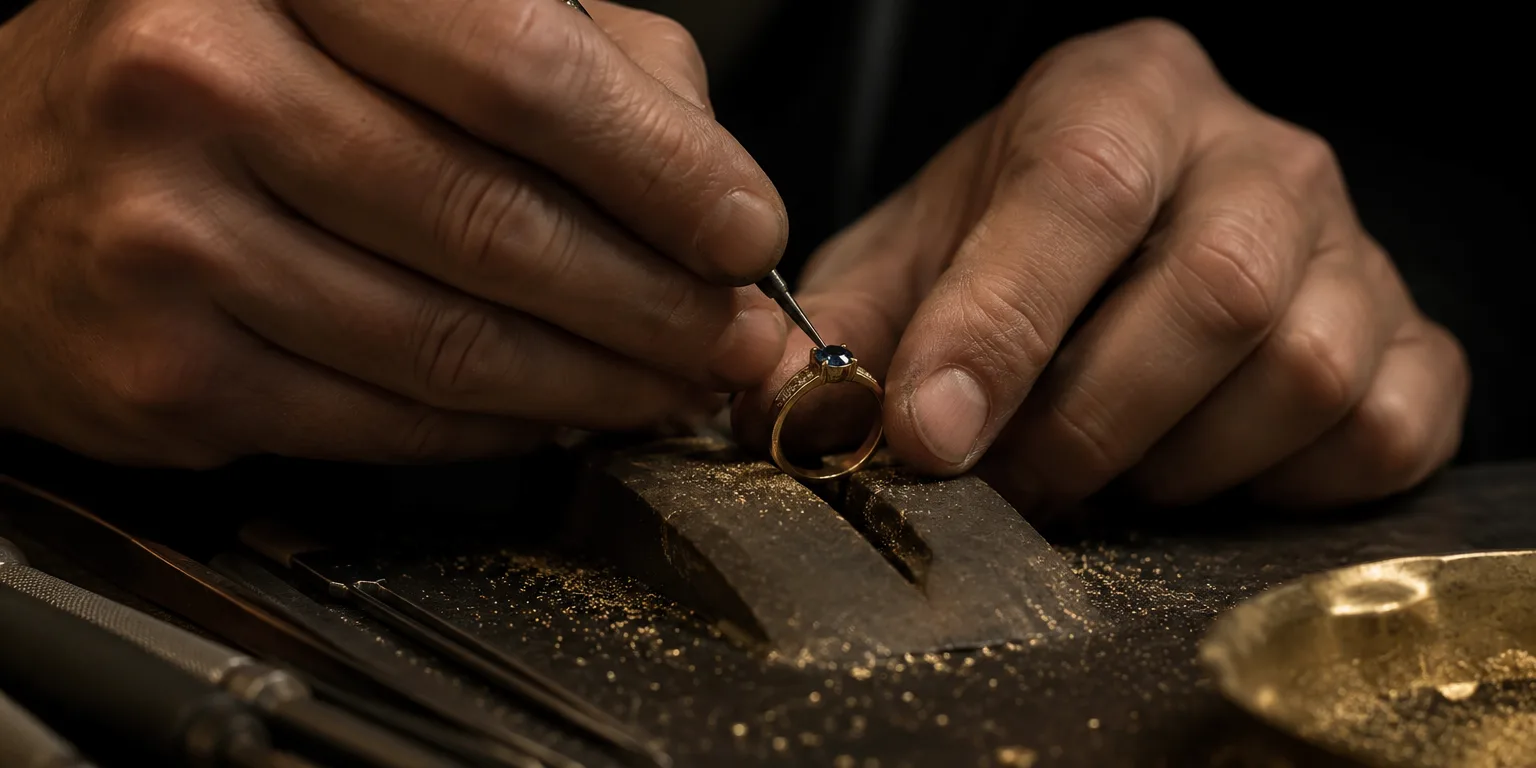
Handmade jewellery is fabricated by a craftsman directly from metal, sawing, forging, soldering and setting by hand, rather than reproduced from a mould. In Sri Lanka the tradition survives in family workshops using techniques such as filigree, repoussé and hand setting. Handwork typically shows subtle individuality, denser construction and finer detail than mass-cast pieces, which is why it commands a premium.
"Handmade" may be the most stretched word in the jewellery trade. At one end it means a craftsman transforming sheet and wire into a finished piece entirely at the bench; at the other it is a label attached to mass-cast items that a human briefly polished. In Sri Lanka, where genuine hand fabrication is still a living trade, the difference matters, to price, to quality and to what you are actually buying.
What "Handmade" Properly Means
In the strict sense, a handmade piece is fabricated directly from metal: the goldsmith saws, files, forges, bends and solders raw material into form, then sets any stones by hand. No mould, no reproduction, each piece is built individually, and no two are precisely identical.
This is distinct from casting, where a model is used to produce a mould from which many identical pieces are made. Casting is legitimate and dominates modern production, we explain it in jewellery manufacturing, but it is a different thing, and the two should not share a label.
The Sri Lankan Hand Tradition
Sri Lanka's traditional jewellery was by necessity handmade, and the skills never died out. Family workshops across the island still fabricate by hand, and several techniques are particularly associated with the local tradition. Filigree builds ornament from fine twisted wire. Repoussé and chasing raise and refine designs in sheet metal, familiar from Kandyan work. Hand engraving cuts decoration directly into the surface, and hand setting secures stones with individually formed prongs, bezels and beads.
These skills traditionally passed from master to apprentice within families, one reason traditional forms are still made properly today, and one reason skilled repair and restoration of old pieces remains available.
Handwork, Casting and the Hybrid Middle
Most jewellery sold today is neither purely handmade nor untouched by hand. A very common modern workflow casts the structural body of a piece, then finishes it by hand: assembly, engraving, setting, polishing. Such hybrids can be excellent, and there is nothing wrong with buying one, provided it is described honestly.
The practical distinction for buyers:
| Aspect | Hand-fabricated | Cast (mass-produced) |
|---|---|---|
| Uniqueness | Each piece individual | Identical multiples |
| Detail | Crisp, worked, slightly irregular | Uniform, sometimes soft |
| Construction | Typically dense, built-up | Can be light or porous if poorly done |
| Labour time | Days to weeks | Hours per batch |
| Price driver | Skilled labour | Volume efficiency |
How to Recognise Handwork
A few habits help. Compare repeated elements, petals, links, beads: in handwork they match closely but not perfectly. Examine detail under magnification: hand-cut lines have crisp walls, cast detail can look softened. Look at the back and inside; hand-fabricated pieces are usually finished where no one looks. And notice the shop context, a design displayed in every size and multiple metals was cast.
None of this replaces the direct question: how was this made? A workshop proud of handwork will answer specifically, often happily. Have the answer written on the invoice alongside metal fineness and stone details, as our guide to buying jewellery in Sri Lanka advises.
What You Are Paying For
Handmade jewellery costs more because skilled time costs more, and that premium surfaces in the making charge rather than the metal price. Understanding making charges lets you see the labour priced explicitly, and the jewellery price calculator helps you separate metal value from workmanship in any quote.
Whether the premium is worth it is a personal judgement. What can be said is that hand fabrication buys individuality, repairability and, at its best, a density of care that production methods do not reach. If that appeals, commissioning is the natural next step: see custom jewellery for how to work with a maker directly.
Frequently asked questions
How can I tell if a piece of jewellery is handmade?
Look for subtle individuality: minute asymmetries in repeated elements, crisp hand-finished detail, and construction that looks built rather than moulded. Identical pieces in multiple sizes on the same tray suggest casting. The most reliable method is simply to ask how the piece was made and have the answer put on the invoice.
Is handmade jewellery better than cast jewellery?
Not automatically. Excellent and poor work exists in both. Handwork offers individuality and, at its best, superior detail and durability; casting offers consistency and lower cost. What matters is honest disclosure and quality of execution.
Why does handmade jewellery cost more?
Time. A hand-fabricated piece can take days or weeks of skilled labour that a casting reproduces in hours. That labour appears in the making charge, which is why understanding making charges helps you read a quote.
Are hybrid pieces common?
Very. Many modern pieces are cast in structure and then hand-finished, hand-engraved or hand-set. A hybrid honestly described is a perfectly good buy; the problem is only casting sold as full handwork.
Sources
- International Gem Society (IGS), General jewellery fabrication and setting concepts
External references are provided for verification. Listing a source does not imply affiliation or endorsement.
Seen something that needs correcting? Read how corrections work or contact the editorial team.
Related Guides
Jewellery
How Is Jewellery Manufactured in Sri Lanka?
How jewellery is made in Sri Lanka, casting and hand fabrication, the workshop-to-factory spectrum, quality control and what methods mean for buyers.
3 min read
Jewellery
How Does Custom Jewellery Work in Sri Lanka?
How commissioning custom jewellery works in Sri Lanka, the design process, choosing stones and metal, agreeing costs, timelines and the paperwork to insist on.
3 min read
Jewellery
What Is Traditional Sri Lankan Jewellery?
A survey of traditional Sri Lankan jewellery, Kandyan, Tamil and low-country styles, classic motifs, materials and the ceremonial roles pieces still play.
3 min read
Jewellery
How Do Jewellery Repair and Restoration Work in Sri Lanka?
Jewellery repair and restoration in Sri Lanka, common repairs, restoring heirlooms sensitively, choosing a workshop and the paperwork to insist on.
3 min read