Gem Geology
How Sri Lanka’s Gem Deposits Form
How gems are formed and concentrated in Sri Lanka: weathering, transport, secondary gem gravels (illam) and the island’s deposit categories, with an original diagram.
Direct answer
Most Sri Lankan gems are recovered from secondary deposits: gem minerals that crystallised in the island’s ancient basement rocks were released by weathering, moved by water and gravity, and settled into buried gravel beds where their high density concentrated them. Miners call this gem-bearing gravel illam. They reach it in pits and shafts, lift it out, and wash it to separate any gem rough from the sand and pebbles around it.
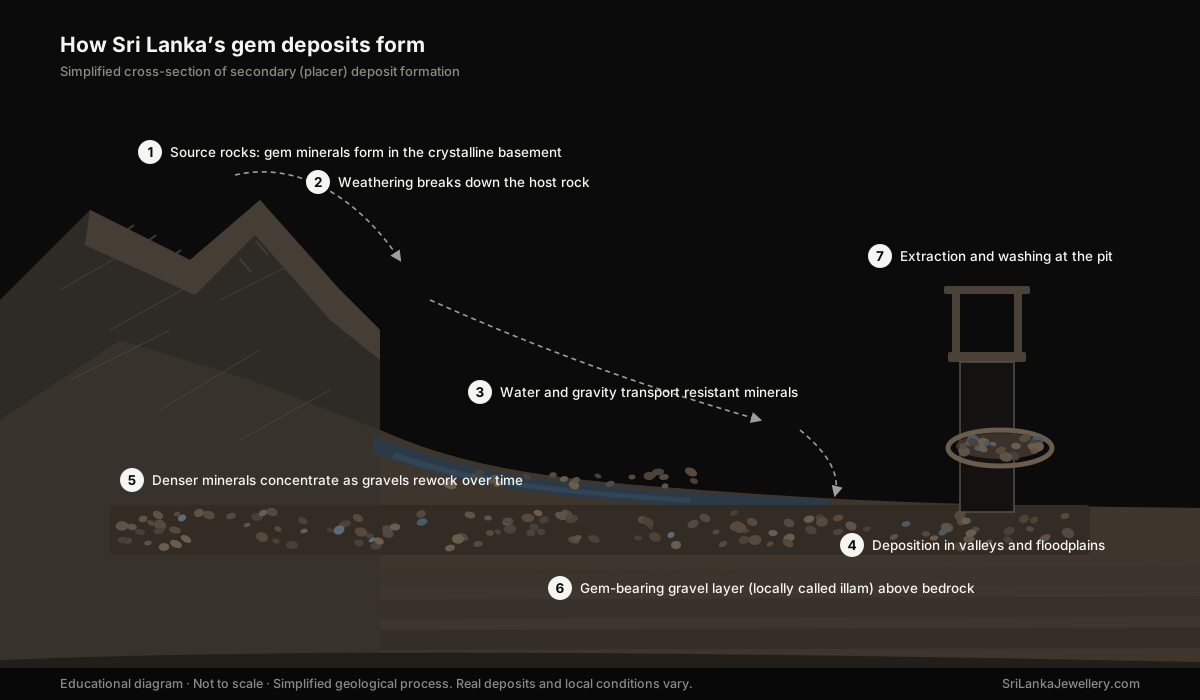
The process, stage by stage
The sequence below matches the numbers in the diagram. It describes the general model for secondary gem deposits; it is not a claim that every Sri Lankan deposit formed in exactly this way, and geologists describe considerable local variation.
- Source rocks. Gem minerals such as corundum, spinel and garnet may occur in primary source rocks. In Sri Lanka these are principally the high-grade metamorphic rocks of the island’s crystalline basement.
- Weathering. Over long spans of time, heat, moisture and chemical attack break the host rock down. Hard, chemically resistant minerals survive this process; corundum, at hardness 9 on the Mohs scale, is a classic survivor.
- Transport. Water and gravity carry the released grains downslope into streams and rivers. Softer material breaks up and disperses along the way; resistant minerals travel as water-worn grains and pebbles.
- Deposition. Where the water slows, in valley floors, floodplains and old river channels, sediment settles out in layers.
- Concentration. Dense minerals settle preferentially. As rivers rework their sediments over time, heavier grains lag behind and accumulate together, which is why a thin layer can hold far more gem material than the rock it came from.
- Gem-bearing gravel. The result is a buried gravel horizon, typically resting on or near bedrock, known locally as illam. It looks unremarkable: wet sand, clay and water-worn pebbles. Any gem rough in it is rounded and dull-skinned, nothing like a cut stone.
- Extraction and washing. Miners sink pits or shafts to the gravel, lift it to the surface and wash it in baskets, so that the dense fraction, including any gems, stays behind while lighter material washes away. Gem mining in Sri Lanka operates under licence; the National Gem and Jewellery Authority lists mining licensing among its formal licence processes.
Deposit categories
The geological literature on gem deposits distinguishes several broad categories. Three are relevant to Sri Lanka; their relative importance differs from place to place.
Sedimentary placer deposits
Placers are the secondary deposits described above and account for most Sri Lankan production. Within the placer family, standard classification distinguishes three settings by how far the material has travelled:
- Residual: the host rock has weathered away in place and the resistant minerals remain essentially where they formed.
- Eluvial: material has crept downslope under gravity but has not entered a river system.
- Alluvial: material has been transported and sorted by rivers, the setting of the classic Sri Lankan gem gravels.
Metamorphic deposits
These are primary occurrences: gem minerals still sitting in the metamorphic rock in which they crystallised. Sri Lanka’s basement is dominated by high-grade metamorphic rock, which is the ultimate source of most of the island’s gem minerals even where the stones are mined from gravels.
Magmatic and pegmatite-related deposits
Pegmatites, very coarse-grained igneous bodies, host certain gem minerals and are described among Sri Lanka’s occurrence types in the literature. They are a smaller part of the picture than the placers.
A caution on maps and prospecting: this page deliberately contains no prospecting guidance and no detailed deposit map. Published overview maps simplify heavily, and the presence of gems in an area can only be established by licensed exploration, not by reading a diagram.
Sources
Sri Lanka: Expedition to the Island of Jewels
Gems & Gemology (GIA), Fall 2014, Vol. 50, No. 3 · Andrew Lucas, Armil Sammoon, A. P. Jayarajah, Tao Hsu, Pedro Padua · Fall 2014 · Accessed 2026-07-25
Gemological Institute of America · Accessed 2026-07-25
Corundum (mindat.org mineral page)
Mindat.org · Accessed 2026-07-25
National Gem and Jewellery Authority of Sri Lanka · Accessed 2026-07-25
General placer terminology (residual, eluvial, alluvial) follows standard usage in economic geology. Statements specific to Sri Lankan localities and mining draw on the Gems & Gemology field report listed above. See the source library and source policy.
Frequently asked questions
How are gems formed?
Gem minerals crystallise in rock under particular combinations of chemistry, pressure, temperature and time; corundum, spinel and garnet, for example, formed in Sri Lanka’s high-grade metamorphic basement. What makes a mineable deposit is a second story: weathering releases the durable crystals, water concentrates them, and the result in Sri Lanka is buried gem-bearing gravel. This page explains that second story stage by stage.
What is illam?
Illam is the local Sri Lankan term for the gem-bearing gravel layer. It is a buried bed of water-worn pebbles, sand and clay in which dense, resistant minerals, including gem minerals, have accumulated. Miners dig down to this layer and wash it to recover any gem rough it contains.
Why are Sri Lankan gems found in river gravels rather than in solid rock?
Most Sri Lankan gem minerals crystallised long ago in the island’s metamorphic basement rocks. Where those rocks have weathered, hard and chemically resistant minerals survived while the surrounding rock broke down. Water and gravity then carried the survivors into valleys, where the denser grains settled and concentrated into gravels. Mining the gravel is often far more practical than mining the fresh host rock, in which gem-quality crystals are sparsely distributed.
Are all Sri Lankan gem deposits secondary?
No. The island’s deposits are predominantly secondary, meaning the gems are recovered from sediments rather than from the rock in which they formed, but primary occurrences in the original host rock also exist, and some pegmatite-related occurrences are described in the literature. The balance varies by locality, and any specific deposit needs to be assessed on its own geology.